Missed or late GLP-1 dose: what to log and who to ask
 PenPal Editorial Team
Short answer: If a GLP-1 dose is late or missed, open the missed-dose section of your medication’s official label or Medication Guide, and ask your pharmacist or prescriber to confirm what it means for you. The instructions differ between medications, and between weekly shots and daily tablets. Then write down the planned time, the actual time or “missed,” the reason, and what you were told and by whom.
What should you do first when a GLP-1 dose is late or missed?
First, take a breath. A late or missed dose happens to almost everyone at some point: travel, a busy week, a pen that ran out, a day you felt unwell. It happens, and it’s fixable. It’s a moment to check the facts before you act.
Then do two things. Look up what your own medication’s label says about a missed dose. And if anything is unclear, ask a pharmacist or your prescriber before your next dose. A pharmacist is often a quick first call.
This guide won’t tell you when to take a missed dose or whether to skip it. That answer depends on your medication, its form and your own plan, and it belongs to your label and your care team. What this guide covers is the part you control: finding the right section, and keeping a clear record.
Where do you find the missed-dose instructions for your medication?
FDA-approved GLP-1 medications come with official labeling. Two parts matter here:
- The Medication Guide. The FDA says a Medication Guide is patient labeling that is given to you on paper when the medicine is dispensed. You can also ask for it electronically. In the Wegovy® Medication Guide, the missed-dose bullets sit under “How should I use WEGOVY?” Look for a similar heading in yours.
- The prescribing information. This is the longer document for clinicians. Its dosage section can include a subsection on missed doses. In the FDA label for Wegovy, it is called “Recommendations Regarding Missed Dose(s).”
MedlinePlus, from the US National Library of Medicine, also has plain-language pages on many medicines. These pages have a section called “What should I do if I forget a dose?” You’ll find it on the pages for semaglutide injection and tirzepatide injection.
Why not just search “missed Ozempic® dose” or “late Mounjaro® injection” and use the first answer? Because the instructions are not the same everywhere:
- Different medications: the MedlinePlus pages for semaglutide and tirzepatide give different missed-dose instructions.
- Same ingredient, different use: the semaglutide injection page gives separate instructions depending on why the medicine was prescribed, for example diabetes or weight management.
- Weekly shot or daily tablet: the Wegovy label covers both the weekly injection and the daily tablets, and each form has its own missed-dose instructions.
So the safest source is the label for the exact product in your hand, read with your pharmacist or prescriber. If you use a compounded medication, ask the pharmacy that made it where its instructions are. Your prescriber may also have given you instructions that differ from the general label. Their instructions come first.
What should you log when a dose is late or missed?
A short, honest entry is enough. Write it the same day, while the details are fresh. These fields cover it:
| Field | What to write | Why it helps |
|---|---|---|
| Planned dose | The day and time the dose was due | Shows how late it was |
| Actual dose | The day and time you took it, or simply “missed” | Keeps your history true |
| Reason | A few words: travel, out of stock, felt unwell, forgot | Helps you spot what to fix |
| Who you asked | Pharmacist, prescriber or nurse line, with the date | Shows the next step was checked |
| What you were told | Their answer, in their words | Saves you from guessing next time |
Here is a made-up example for a weekly shot. It shows no dose amounts, because yours come from your label.
| Planned | Actual | Reason | Who you asked and what they said |
|---|---|---|---|
| Mon 9:00 AM | Mon 9:10 AM | None | Not needed |
| Mon 9:00 AM | Tue 7:30 PM | Away for work, pen at home | Pharmacist, by phone: went through my Medication Guide with me |
| Mon 9:00 AM | Missed | Refill delayed | Prescriber’s office: they set my next step; call if it happens again |
| Mon 9:00 AM | Mon 8:45 AM | None | Back on my usual day |
Two small habits keep the record honest. Log a late dose at the time you actually took it, not the time it was planned. And never log a dose you didn’t take just to keep the schedule tidy. If you track an estimated medication level, it is calculated from the times in your log, so true times give a truer curve. For the everyday fields of a dose entry, see what to record for each GLP-1 dose.
Why shouldn’t you double up or catch up on your own?
It can feel natural to “make up” for a missed dose. Please don’t decide that on your own. The missed-dose sections on MedlinePlus for both semaglutide and tirzepatide include a limit on this, and the details differ between them. The National Institute on Aging also warns: don’t take a larger dose of a medicine thinking it will help you more.
The same goes for moving your dose day or changing your schedule after a miss. Some labels also treat one missed dose differently from several in a row. If you’ve missed more than one dose, or you’re not sure how many, call your prescriber before your next dose. Restarting may need a plan that only they can make.
What should you ask your pharmacist or prescriber?
The MedlinePlus page for semaglutide injection says you will be given the Medication Guide, and asks you to talk to your doctor or pharmacist if you have questions. Bring your log and questions like these:
- Which section of my label covers a missed dose, and how does it apply to me?
- Do your instructions for me differ from the general label?
- What should I do if I miss more than one dose in a row?
- If I need to change my usual dose day, how should I do it?
- Is there anything I should watch for after a late dose?
- Who should I call if this happens outside office hours?
- If my refill is delayed, what are my options?
Write the answers in your log with the date. Next time, you’ll have your own instructions in front of you, not a half-remembered search result.
What if late doses keep happening?
One late dose is a note. Several in a row are a pattern, and a pattern is worth raising at your next visit. It isn’t about blame. Your prescriber can only help with what they can see, and a dose day that never fits your week is a real, fixable problem.
Look at your reasons column. If you see the same reason again and again, it points to the fix:
- “Forgot”: a reminder at a better time, or tying the dose to something you already do.
- “Away from home”: planning around trips, and asking how to travel with your medicine.
- “Out of stock” or “refill delayed”: tracking your supply and ordering earlier.
- “Felt unwell”: a conversation with your prescriber about side effects. A dose increase log can help if it started after a step-up. If symptoms are severe or worrying, contact a clinician right away, and in an emergency, call local emergency services.
Reminders work best when they match your life. The National Institute on Aging suggests meals or bedtime as cues, plus charts, calendars, pill boxes, timers and reminder apps. If you take a daily tablet, our oral GLP-1 pill log guide covers a simple daily record.
Common mistakes when logging a late or missed dose
- Using a rule from someone else’s medication. A forum answer about Zepbound® doesn’t apply to semaglutide, or to a tablet.
- Logging the planned time instead of the real one. Your log, and any estimate built on it, then shows something that didn’t happen.
- Leaving the gap blank. “Missed” is useful information. A blank row could mean anything.
- Not writing down the advice. If you don’t note who said what, you’ll be guessing again next time.
- Being hard on yourself. A missed dose is a reason to plan, not a reason for guilt.
How PenPal helps
PenPal records your treatment as it happens, late doses included. It never tells you when to take a missed dose, whether to skip it or how much to take. That stays with your label and your care team. See the GLP-1 shot tracker.
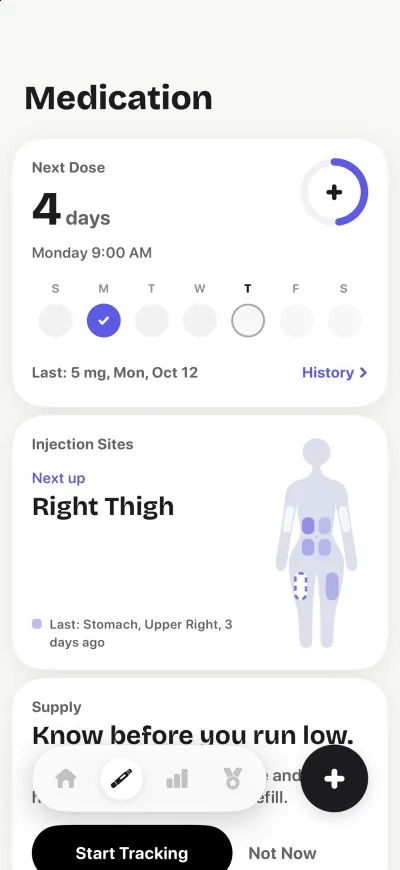
- Log the real time: when you log a dose, you can set the day and time you actually took it, so a late dose sits where it belongs.
- A calm overdue card: if your dose day passes without a logged dose, the card reads “Ready When You Are” and asks you to log the dose once you’ve taken it.
- Taking a break: if you’re pausing on your prescriber’s advice, “Taking a break?” turns dose reminders off. Logging a dose picks things back up.
- Dose history you can fix: if you logged a dose by mistake, delete it from Dose History. It also comes off your estimated level and schedule.
- Reminders: get a dose reminder at dose time, one, two or four hours before, or the evening before. Discreet Reminders keep the medication name off your lock screen, and if you track your supply, a refill reminder lets you know when it’s running low.
Pick a date range, and PenPal builds a PDF progress report. Its dose section can show how many doses you logged out of those scheduled, the longest gap between doses, and a dose log by date. That makes a pattern of late doses easy to discuss with your prescriber. Our guide to making a GLP-1 progress report for your doctor shows how to use it. You decide whether to share it, and with whom.
Sources
- MedlinePlus: Semaglutide injection
- MedlinePlus: Tirzepatide injection
- FDA: Wegovy (semaglutide) injection and tablets prescribing information
- FDA: Patient labeling resources (Medication Guides)
- National Institute on Aging: Taking medicines safely as you age
- MedlinePlus: Taking multiple medicines safely
This guide is educational and doesn’t replace individual medical advice. Follow your prescription and talk to your clinician about your treatment.