How the estimated medication level is drawn, and what it can’t tell you
 PenPal Editorial Team
Short answer: PenPal’s estimated medication level is a curve calculated from the doses and times you log, using published average values for your medicine, such as its half-life and time to peak. It isn’t a blood test and knows nothing about your body. Use it to see patterns, never to change a dose.
What is the estimated medication level?
It’s a pharmacokinetic estimate: a curve that models how much of your medicine might be in your body over time, based only on the doses you log and published averages for that medicine. Think of it as a drawing of a typical pattern, not a reading of yours.
Pharmacokinetics is the study of how a medicine is absorbed and cleared by the body. Drug labels summarize it with a few averages measured in clinical studies, such as how long the medicine takes to reach its highest level and how long it takes for half of it to clear, called the half-life. PenPal takes those published averages and applies them to the doses in your log.
The result answers a narrow question: “If my body behaved like the average person in those studies, roughly how would the level rise and fade between my logged doses?” That can be a handy picture. For example, you might notice that food noise tends to come back at the same point in your week. It is not an answer to how much medicine is actually in you.
Which inputs does the estimate use?
Three things from your log: which medicine each dose was, how much you logged, and when you logged taking it. Everything else comes from published averages for that medicine.
- Product: the medicine and form you picked, such as a semaglutide injection or semaglutide tablets. Each has its own set of published values.
- Dose: the amount as you logged it, the way your label or prescription reads.
- Date and time: when you logged each dose. A dose logged at the wrong time moves the curve with it.
A few details matter. If you log a compounded vial in syringe units, the card counts in units, and PenPal never converts units into milligrams or the other way around; only doses logged in the card’s unit feed the curve. If you add a medicine PenPal doesn’t have values for, it draws a generic default curve, so treat that estimate even more loosely. For what to record with each dose, see what a GLP-1 medication tracker records.
Which published values does the estimate rely on?
Mainly two numbers from each medicine’s US prescribing information: the half-life and the typical time to the highest level after a dose. Here is what the current labels say, from section 12.3 (Pharmacokinetics) of each.
| Medicine | Label checked | Half-life | Highest level after a dose |
|---|---|---|---|
| Semaglutide injection | Ozempic® | About 1 week | 1 to 3 days |
| Semaglutide tablets | Rybelsus® | About 1 week | About 1 hour |
| Tirzepatide injection | Mounjaro® | About 5 days | 8 to 72 hours |
| Liraglutide injection | Saxenda® | About 13 hours | About 11 hours |
Where a label gives a range, such as “1 to 3 days,” the app has to pick one typical value inside or near it to draw a single curve. That’s why we describe the inputs as published averages: real people land all over those ranges. The labels add context that matches the shape you’ll see. The Ozempic label says steady exposure is reached after 4 to 5 weeks of weekly doses, and the Mounjaro label says after 4 weeks.
How is the curve calculated?
Each logged dose gets its own small curve: it rises as the dose is absorbed, peaks around the label’s typical time, then falls by half every half-life. PenPal adds all those small curves together, so overlapping doses stack up.
This is a standard textbook model, with one “compartment” for the body and a steady rate for absorption and for clearance. It’s deliberately simple. It knows nothing about you; it only knows the shape the averages describe.
Stacking explains a pattern many people notice early on. With a weekly medicine whose half-life is about a week, roughly half of one dose’s modeled amount is still there when the next dose arrives. So during the first weeks the curve climbs from one cycle to the next, then settles into a repeating wave. That’s the model doing arithmetic, not a sign that anything is building up or wearing off in your body.
What doesn’t the estimate know?
Almost everything about you. The estimate sees your log and a set of averages. It can’t see your body, and it can’t see what never made it into your log.
- Your body: size, age, kidney and liver function, and how you personally absorb and clear the medicine.
- Missing or wrong logs: a dose you took but didn’t log, a dose logged twice, or the wrong time or amount.
- How the dose went in: the injection site, a pen or syringe that didn’t deliver the full dose.
- For tablets: the conditions you took them under, which the label says can change how much is absorbed.
- Everything else: other medicines, illness, vomiting or diarrhea, food and the rest of your day.
Because of all this, two people with identical logs see identical curves, even though their real levels could differ.
Why isn’t the estimate a blood test or medical reading?
Because nothing is measured. A blood test samples your blood in a lab. The estimate is arithmetic on your log, so it can’t confirm, rule out or diagnose anything.
The number on the card is shown in the same unit as your doses, usually milligrams. It’s a modeled amount, not a concentration in your blood. It also doesn’t adjust for how much of a dose reaches the bloodstream, which varies a lot by product: the tablet label gives an absolute bioavailability of about 0.4% to 1% for Rybelsus, while the Ozempic label gives 89% for semaglutide injection. So a tablet’s number and a shot’s number can’t be compared, and neither can your number and someone else’s.
Read the curve for its shape over your own weeks: when it tends to rise, when it eases. Don’t read it as a value with medical meaning.
Why should you never use the estimate to change a dose?
Because it reflects your log and a set of averages, not your body or your prescription. A curve that looks “low” before your next dose is how the model is shaped, not a signal to take, repeat, move or skip anything.
Dose amounts and timing are decided by your prescriber, following your product’s label. If you have questions about a late dose, a missed dose or how you feel, ask your prescriber or pharmacist, not the curve. Exact instructions matter: the FDA has warned about dosing errors with some compounded injectable semaglutide products. The PenPal FAQ on the medication level says it plainly too: the estimate is never a reason to repeat, delay or change a dose.
How does PenPal show the estimate?
On the Medication Level card, as a number labeled “Estimated right now” and a curve built from your logged doses. Under the chart, the card adds: “An estimate from the half-life in the US prescribing information, not a lab value.”
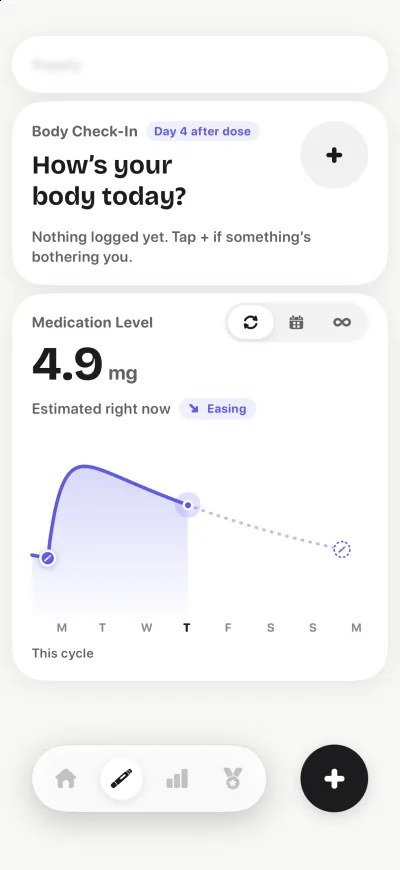
- Right now: the current estimate, with a chip that compares it with six hours earlier: Rising, Easing or Steady.
- Ranges: switch between this cycle (the last 7 days for daily doses), the last 4 weeks, and all doses since your first.
- Dose markers: each logged dose sits on the curve. Ahead of today, a dotted line shows how the estimate would ease until your next scheduled dose, if no other dose is logged.
- Drag to look back: slide along the chart to see the estimate at any moment, the dose amount and date on a dose, or the day of your cycle.
The level card sits next to your dose log, reminders and injection-site map in the GLP-1 shot tracker. For the bigger picture of what to log and why, start with the GLP-1 medication tracker guide, or see how tracking apps work.
Sources
- DailyMed: Ozempic (semaglutide) injection, prescribing information, section 12.3 (checked November 7, 2026)
- DailyMed: Rybelsus and Ozempic (semaglutide) tablets, prescribing information, section 12.3 (checked November 7, 2026)
- DailyMed: Mounjaro (tirzepatide) injection, prescribing information, section 12.3 (checked November 7, 2026)
- DailyMed: Saxenda (liraglutide) injection, prescribing information, section 12.3 (checked November 7, 2026)
- FDA: Dosing errors associated with compounded injectable semaglutide products (checked November 7, 2026)
This guide is educational and doesn’t replace individual medical advice. Follow your prescription and talk to your prescriber or pharmacist about your treatment.