How to track protein and fiber on a GLP-1
 PenPal Editorial Team
Short answer: Log each meal with a rough estimate of its protein and fiber, then look at the week rather than any single day. Use the targets your clinician or dietitian gave you, favor consistency over precision, and let photos or package labels do the heavy lifting.
Why people track them
When appetite is lower, meals tend to get smaller, and it becomes easier to lose track of what those meals actually contain. Many people on GLP-1 medication keep an eye on protein and fiber for that reason, often because their clinician or a dietitian asked them to. Your own targets should come from your care team; a tracker’s job is to show you how close your meals get.
Tracking also answers questions that are hard to answer from memory. Did most of your protein come at dinner? Did fiber drop on busy days? Did you eat much at all on the day after your dose? A simple log turns “I think I ate okay” into something you can actually look at.
Where protein and fiber come from
Protein comes mostly from meat, fish, eggs, dairy, tofu, beans and lentils. Fiber comes from plants: fruit, vegetables, beans, lentils, oats and whole grains. Beans and lentils are the overlap, so they help on both counts.
Protein: meat, fish, poultry, eggs, tofu, beans, lentils and dairy are common sources. MedlinePlus notes that one ounce of most protein-rich foods contains about 7 grams of protein, which makes rough estimates surprisingly easy.
Fiber: fruit, vegetables, beans, lentils, oats and whole grains carry most of it. MedlinePlus explains the difference between soluble fiber, which turns to gel during digestion, and insoluble fiber; most plant foods have some of each.
| Food group | Mostly brings | Examples |
|---|---|---|
| Meat, fish, poultry | Protein | Chicken, salmon, lean beef |
| Eggs and dairy | Protein | Eggs, yogurt, cottage cheese, milk |
| Beans and lentils | Protein and fiber | Black beans, chickpeas, lentils |
| Soy foods | Protein | Tofu, tempeh, edamame |
| Whole grains | Fiber | Oats, brown rice, whole wheat bread |
| Fruit and vegetables | Fiber | Berries, apples, broccoli, carrots |
How do you read a food label for protein and fiber?
Start with the serving size, then find the grams of protein and dietary fiber for that serving. If you ate two servings, double the numbers. The label is the most exact number you’ll get without weighing anything.
The FDA’s guide to the Nutrition Facts label explains the percent Daily Value (%DV) column, too. As a rule of thumb, 5% DV or less of a nutrient per serving is low, and 20% DV or more is high. That makes it quick to compare two cereals or two breads for fiber. Many labels show grams of protein without a %DV, so log the grams.
Keep in mind that %DV is based on a general daily amount for the public, not on your plan. Your own targets come from your care team.
Log without a food scale
You don’t need a scale to keep a useful log. Labels, your hand, a photo and your usual meals get you close enough to compare one day with the next.
- Use the label: packaged foods list protein and fiber per serving.
- Use your hand: a palm-sized portion of meat or fish, or a cupped handful of beans, is a consistent enough unit to compare days.
- Snap it: a photo now beats a perfect entry later. You can fix the numbers afterward.
- Repeat favorites: most people eat the same few breakfasts and lunches. Save them once and reuse them.
Consistency matters more than precision. If your “palm of chicken” is always a little bigger than the real serving, your log is still fair to itself. You’ll still see which days were higher and which were lower.
What does a day of logging look like?
A day of logging is just a short list: what you ate, where the number came from, and a rough protein and fiber estimate. Here is a made-up example. Label values are whatever your own package says, so the “label” rows show no numbers.
| Meal | What you ate | Where the number came from | Note |
|---|---|---|---|
| Breakfast | Yogurt cup with berries | Label for the yogurt, photo for the berries | Small appetite this morning |
| Lunch | Chicken salad, about 3 oz chicken | Hand portion: about 21 g protein | Ate half, saved the rest |
| Snack | Apple | Photo estimate | Before a walk |
| Dinner | Lentil soup, one bowl | Label on the can | Felt full quickly |
The lunch row uses the MedlinePlus rule of thumb: about 7 grams of protein per ounce, so 3 ounces is about 21 grams. That kind of quick math is all you need. The notes column matters, too. “Ate half” and “felt full quickly” explain a low day better than any number.
Read the week, not the day
A single day says little, especially around dose day when appetite can shift. Over a week, patterns show up: which meals carry most of your protein, which days fiber drops, and whether a symptom tends to follow a particular kind of meal. Those are good notes to bring to your clinician or dietitian.
Once a week, take two minutes and ask yourself:
- Which meals brought most of my protein? Is one meal doing all the work?
- On which days was fiber lowest, and what was different about them?
- Did I eat less on certain days after my dose?
- Did any meals tend to come before a symptom? If so, note it in your side effect diary.
- What do I want to ask my clinician or dietitian?
Common logging mistakes
Most food logs fail because they get too hard to keep, not because the numbers are wrong. Watch for these:
- Chasing perfect numbers. A close estimate you log today beats an exact one you never enter.
- Skipping small meals. On lower-appetite days, a yogurt or a handful of nuts may be most of what you ate. Log it.
- Forgetting drinks. Milk, protein shakes and smoothies can carry real protein.
- Judging one day. A low day is just a data point. The week tells the story.
- Using someone else’s targets. Online numbers aren’t made for you. Ask your care team.
How PenPal helps
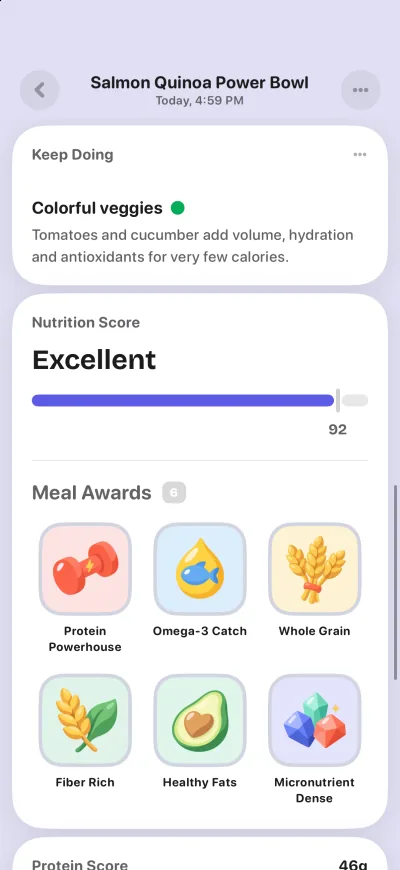
Snap a photo of your plate or describe it in a few words, and PenPal’s AI estimates calories, protein, fiber and macros, then scores the meal. Estimates can be off, so you can edit anything. It’s there to make logging easier, not to prescribe a diet. See the protein and fiber tracker.
- Three ways to log: take a photo, describe the meal in words, or scan a barcode for the exact label values.
- Recent meals: log your usual breakfast again without starting from scratch.
- Protein and fiber first: see them add up, day by day, next to your goal.
- Nutrition score and awards: each meal gets a score from 0 to 100, plus awards such as Protein Powerhouse or Fiber Rich. It’s encouragement, never judgment.
Your logged meals can also go into a PDF progress report for your next appointment. For everything else worth logging, from doses to weight, read what a GLP-1 medication tracker records.
Sources
- MedlinePlus: Protein in diet
- MedlinePlus: Soluble vs. insoluble fiber
- Dietary Guidelines for Americans
- FDA: How to understand and use the Nutrition Facts label
- NIDDK: Health tips for adults
This guide is educational and doesn’t replace individual medical advice. Follow your prescription and talk to your clinician about your treatment.