GLP-1 supply and refill log: never run out by surprise
 PenPal Editorial Team
Short answer: Keep a simple log of the GLP-1 medication you have at home: what it is and its strength as the label reads, how many doses are left as your label or pharmacist counts them, the expiry date and the lot number. Note the day your supply will run out, and start your refill well before it, so there is time for the pharmacy, your insurance and any surprises.
What should a GLP-1 supply log include?
A supply log answers one question: how long will what I have at home last? Running out by surprise is stressful, and it’s rarely anyone’s fault. A refill can take longer than expected, a box can sit at the back of the fridge, or it’s easy to lose track of how many doses are left. A few fields keep the picture clear.
- Medication and form: the name, and whether it is a pen, a vial or tablets.
- Strength: copied from the carton or label, in the same unit.
- Doses left: the number of doses you have at home, as your label or pharmacist counts them.
- Opened date: the day you started a new pen, vial or pack.
- Expiry date and lot number: both are printed on the carton or label.
- Where it came from: the pharmacy and the date you picked it up.
How many doses are in an Ozempic® pen, or in a box of Mounjaro® pens? This guide deliberately doesn’t answer that. Pens and packs differ by product and strength. MedlinePlus notes that tirzepatide comes in a vial, a single-use pen or a pen used for more than one dose. So the only count that applies to you is the one on your carton and label, or the one your pharmacist gives you. Write it down when you pick up your medication, while the box is still in your hand.
The supply notes below are made up. They leave out dose amounts and doses-per-pen numbers on purpose: those come from your own carton and pharmacist.
| Date | What happened | From the label | Note |
|---|---|---|---|
| Oct 2 | Picked up a new carton | Strength, expiry and lot copied | Asked the pharmacist how many doses it holds |
| Oct 4 | Opened a new pen | Same strength as before | Wrote the opened date in the log |
| Oct 21 | Asked for a refill | – | Pharmacy said it needs approval from my insurance first |
| Oct 27 | Refill ready | New expiry and lot copied | Counted doses left at home before adding the new ones |
Keep your everyday dose log next to it: date, time, amount as your label reads and, for shots, the injection site. Our guide to what to record for each GLP-1 dose covers those fields. If you prefer paper, our printable GLP-1 log works for supply notes, too.
When should you plan a GLP-1 refill?
Earlier than feels necessary. Wondering when to refill Mounjaro or Wegovy®? Work backward from the day your supply runs out, not from the day you open the last pen or pack. Several things can add time between “I need a refill” and “it’s in my fridge”:
- The pharmacy: your strength may need to be ordered in. Ask your pharmacy how much notice it usually needs.
- Your prescription: if you have no refills left, your prescriber needs to send a new prescription first.
- Your insurance: some plans ask for prior authorization. HealthCare.gov describes it as approval from a health plan that may be required before you fill a prescription for it to be covered. That approval can take time, and it may need to be renewed.
- Supply problems: sometimes a medication or a strength is hard to find.
For supply problems, the FDA keeps a public drug shortage database. You can search it by generic name, such as semaglutide or tirzepatide. The FDA explains that “Resolved” means supply from at least one manufacturer covers total demand, but some manufacturers may not have every presentation available. So a single strength can still be hard to find at your pharmacy. If that happens, talk to your pharmacist and your prescriber. Don’t change how you take your medication on your own.
Keep the plan simple. Write the date your supply runs out in your log, and set yourself a refill reminder well before that date. When you ask for the refill, write down the date and what the pharmacy told you.
How should you store and check your supply?
Storage rules come from your medication’s label, not from a blog. Look for the storage section in the Medication Guide or the Instructions for Use that came with your medication. It tells you how to store unopened and opened pens, vials or tablets, and for how long. MedlinePlus, for example, says to keep semaglutide in the container it came in, and to keep tirzepatide in its original carton until use to protect it from light. If anything is unclear, ask your pharmacist.
Check the expiry date when you pick up your medication and again before you open it. The FDA says the expiration date is printed on the label or stamped on the bottle or carton, sometimes after “EXP,” and that you shouldn’t use a medicine after it has expired. Your pharmacist can tell you how to get rid of medication you no longer need.
Why log the lot number? It helps if there is ever a question about a product. In one case, the FDA warned about counterfeit Ozempic found in the U.S. supply chain and named the lot number on the label. The FDA advises getting your medication with a valid prescription from a state-licensed pharmacy and checking it for signs of counterfeiting before use. If you use a compounded medication, the same habits apply: note what the label says and where it came from.
How do you plan your supply for travel?
Before a trip, check your log: will what you have at home cover the trip, plus a few extra days? The CDC’s advice on traveling with medicine covers the basics:
- Take enough medicine for the whole trip, plus extra in case of travel delays.
- Pack medicines in your carry-on, in case your luggage is lost or delayed.
- Keep medicines in their original, labeled containers.
- Bring copies of your prescriptions.
- Find out how to store your medicine while traveling and whether it needs refrigeration.
- Ask your prescriber for a note if you use injectable medicines, and ask about dose timing if you change time zones.
For flights in the U.S., the TSA says medically necessary liquids over 3.4 ounces (100 mL) are allowed in carry-on bags in reasonable quantities. Tell the officer about them at the start of screening. If you travel abroad, check the rules of your destination, too. Add a travel note to your supply log, so you know what you packed and what is waiting at home.
What should you log when your pharmacy or pen changes?
A change is the moment a supply log is most useful. A new pharmacy, a new pen, a new strength or a switch between a pen and tablets can all change how you count. Give each change a dated entry:
- New strength: copy the new strength from the new carton. Keep your remaining supply at the old strength listed on its own line, and ask your prescriber or pharmacist what to do with it.
- New pen or form: ask your pharmacist how to count doses for it, and write the answer down in their words.
- New pharmacy: note its name and phone number, and how much notice it needs for a refill.
- New prescription: note the date, who wrote it and how many refills it allows.
Moving up a step? Our GLP-1 dose increase log covers what to write at each step. On weekly pens, our Ozempic and Wegovy tracker guide shows how to log a new pen strength. On tablets, see our oral GLP-1 pill log.
What should you ask your pharmacist?
Your pharmacist is the best person to ask about your supply. MedlinePlus suggests asking your pharmacist any questions you have about refilling your prescription. Bring your log and questions like these:
- How many doses does this carton or pack hold for my prescription?
- How should I store it before and after I open it, and for how long?
- How much notice do you need for a refill? Can you tell me when my strength is hard to get?
- Does my plan need prior authorization, and when does it need to be renewed?
- What should I do if my refill isn’t ready before my supply runs out?
- How do I get rid of used pens, needles or expired medication?
Date each answer so you can find it again next time.
Common supply mistakes
- Counting from memory. Count from the carton and your dose log, not from what you think is left.
- Counting pens instead of doses. A pen and a dose aren’t always the same thing. Use the count from your label or pharmacist.
- Waiting for the last pen. By then, there may be no time for a delay. Plan from the run-out date.
- Forgetting the expiry date. A box at the back of the fridge may expire before you reach it.
- Mixing strengths. After a change, keep old and new strengths on separate lines.
- Following online dose counts. Forum posts aren’t your label. Your carton, your prescriber and your pharmacist are.
How PenPal helps
PenPal keeps your doses, side effects, meals, water and weight in one place. It records your treatment; it never tells you how much to take or how many doses a pen holds. On the Medication tab, an optional Supply card can keep your count for you. See the GLP-1 shot tracker.
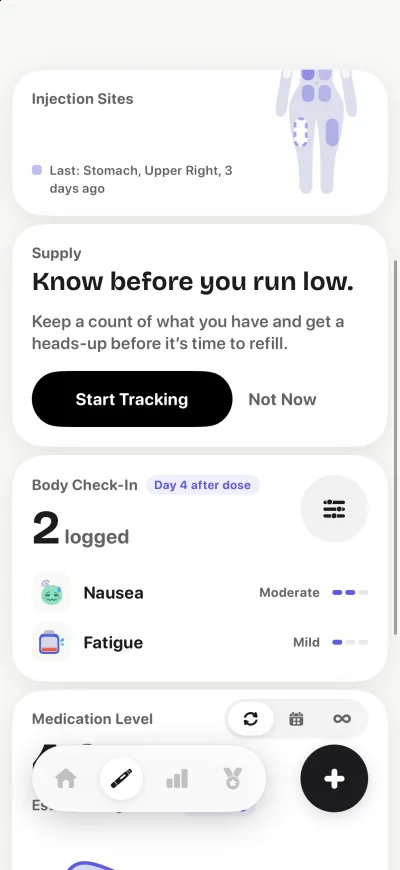
- Your count, your numbers: tap Start Tracking and enter every dose you have at home, as your label or pharmacist counts them. For tablets, you enter the tablets you have. For a vial, you enter the units left.
- Counts down as you log: each dose you log comes off the count. Delete a dose, and it goes back.
- Enough until: the card shows the doses left and roughly when your supply runs out, based on your dose schedule.
- Refills and corrections: tap + to add a new box, pen or vial, or correct the count to what you have right now.
- Low Supply reminder: a morning heads-up 3, 7, 10 or 14 days before your supply runs out. You can turn it off in Settings. With Discreet Reminders on, it leaves out the medication name.
Logging is never blocked. If you log a dose after the count reaches zero, PenPal simply says your count may be off and lets you correct it.
Sources
- MedlinePlus: Semaglutide injection
- MedlinePlus: Tirzepatide injection
- FDA: Drug shortages database
- HealthCare.gov: Prior authorization
- FDA: Don’t be tempted to use expired medicines
- FDA: Counterfeit Ozempic (semaglutide) found in U.S. drug supply chain
- CDC: Traveling abroad with medicine
- TSA: Travel tips
This guide is educational and doesn’t replace individual medical advice. Follow your prescription and talk to your clinician about your treatment.