 PenPal Editorial Team
Short answer: Each time your GLP-1 dose goes up, write down the new strength exactly as the label reads, the date of your first dose at that step, and who made the change. Then log side effects, appetite, meals and water for the weeks that follow, and bring that log and your questions to your prescriber, who sets the schedule.
How does a GLP-1 dose increase schedule work?
Most GLP-1 medications start low and go up in steps. Your prescriber decides how many steps you take, how long you stay on each one and where you stop. People often call this “titrating up.” Your schedule is personal, so the only dose chart that counts is the one on your prescription and in your medication’s official labeling.
The public sources describe the general pattern. For semaglutide injection, MedlinePlus says your doctor will probably start you on a low dose and may increase it after 4 weeks, and again after another 4 weeks, based on how your body responds. For tirzepatide injection, MedlinePlus says the dose is raised gradually, not more than once every 4 weeks. The FDA prescribing information for Wegovy® injection says the step-by-step schedule is there to reduce the risk of stomach and gut side effects.
Searching for an Ozempic® dose chart or a Zepbound® dose schedule? This guide deliberately doesn’t print one. Copy your own steps from your prescription and carton into your log instead, because that is the schedule that applies to you, and your prescriber may adjust it along the way. What this guide covers is the part you control: keeping a clear record of each step and of how the weeks after it went.
What should you log when your dose goes up?
A step-up is a change point in your treatment, so give it a proper entry. Five fields cover it. Write them on the day of your first dose at the new strength, while the carton is still in your hand.
| Field | What to write | Why it helps |
|---|---|---|
| Medication and strength | The name and strength exactly as printed on the carton or label, in the same unit | Avoids mix-ups between pens, vials and tablets |
| First dose at this step | Date and time of the first dose at the new strength | Marks where the “before” ends and the “after” begins |
| Who changed it | Your prescriber’s instruction, in their words, with the date | Shows the step was planned, not guessed |
| How the last step went | One or two lines on side effects, appetite and energy at the previous strength | Gives your prescriber a quick baseline |
| Anything else that changed | A new pen, a new pharmacy, travel, illness or another new medicine | Keeps other causes in view |
Keep every regular dose in the log, too: date, time, amount as your label reads and, for shots, the injection site. Our guide to what to record for each GLP-1 dose covers the everyday fields. If you’re on a weekly pen, the Ozempic and Wegovy tracker guide shows how to log a new pen strength as a dated note.
Are side effects like nausea more common after a dose increase?
For some people, yes. The FDA prescribing information for Wegovy says its gastrointestinal side effects were reported most often during dose escalation, the stepping-up phase. In its clinical studies of adults using it for weight reduction, nausea was reported by 44% of people on Wegovy injection compared with 16% on placebo. That’s one medication’s label, but it’s a good reason to keep notes in the weeks after any step.
The same label’s Medication Guide lists nausea, diarrhea, vomiting, constipation, stomach pain, upset stomach, belching and heartburn among the most common side effects. It also notes that diarrhea, nausea and vomiting can cause a loss of fluids, and asks you to tell your healthcare provider right away about nausea, vomiting or diarrhea that does not go away. A log makes that call easier: you can say when it started, how strong it was and whether you kept fluids down.
Your log describes; it doesn’t decide. Whether a symptom is a side effect, and what to do about it, is for your prescriber. If something feels severe or worrying, contact a healthcare professional, and in an emergency, call local emergency services. Our GLP-1 side effect diary guide covers what to note for each symptom.
How do you watch the weeks after a step-up?
Keep it light: a short check-in on the days you notice something, and a quick look back at the end of each week. Count days from your dose, so a pattern like “queasy on day 2” is easy to spot.
Here is a made-up example of the first week at a new strength. It doesn’t show any dose amounts, because yours come from your label.
| Day | Days since dose | What you noticed | Context note |
|---|---|---|---|
| Sun | Dose day | First dose at the new strength | Strength copied from the carton |
| Mon | Day 1 | Mild nausea in the afternoon | Small lunch, felt full fast |
| Tue | Day 2 | Moderate nausea, low appetite | Mostly yogurt and soup, sipped water all day |
| Thu | Day 4 | Mild fatigue | Short night |
| Sat | Day 6 | Nothing new | Appetite closer to usual |
Beyond symptoms, a few other notes make the picture clearer:
- Meals: what you managed to eat, even if it was small. Our guide to tracking protein and fiber on a GLP-1 shows how to log a low-appetite day without a scale.
- Water: a rough count of glasses, especially on days with nausea, vomiting or diarrhea.
- Weight: your usual routine, read as a trend over weeks. See how to track weight on a GLP-1 without obsessing.
- Energy and sleep: one word is enough: good, okay, low.
At the end of each week, compare it with the last few weeks at your previous strength. Did symptoms show up on the same days? Were they milder, stronger or about the same? Did they fade as the weeks went on? Those comparisons are exactly what’s hard to remember in a 15-minute appointment.
What questions should you bring to your prescriber?
MedlinePlus suggests going into any visit with a list of the questions and concerns you want to talk about, plus a list of the medicines and supplements you take. For a dose step, bring your log and questions like these:
- What are my steps, and how long do you expect me to stay on each one?
- What should I do if a step is hard to tolerate? Who do I contact, and how?
- Which side effects should I report right away, and which can wait until my next visit?
- Is there anything I should change about meals or fluids during the first weeks of a new step?
- What should I do if I miss a dose or my pharmacy doesn’t have my strength?
- How will we decide whether to stay at this step or move on?
When you get answers, write them in your log with the date, in your prescriber’s words. Next time, you’ll know exactly what was agreed. Our guide to making a GLP-1 progress report for your doctor shows how to fit all of this onto one page.
Common logging mistakes around a step-up
- Logging from memory. Copy the strength from the carton, not from what you think the next step was.
- Skipping the boring weeks. A week with nothing new is useful data. It shows how a step settled.
- Only logging the bad days. If you only write on rough days, your log looks worse than your weeks felt.
- Judging the step on day 2. One rough day is a data point. Look at the whole week, then talk it over with your prescriber.
- Comparing with someone else’s schedule. Online dose charts and forum timelines aren’t your plan. Your prescriber’s instructions are.
How PenPal helps
PenPal keeps your doses, symptoms, meals, water and weight on one timeline, so a step-up and the weeks after it sit side by side. It records your treatment; it never tells you which dose to take or when to change it. See the GLP-1 shot tracker.
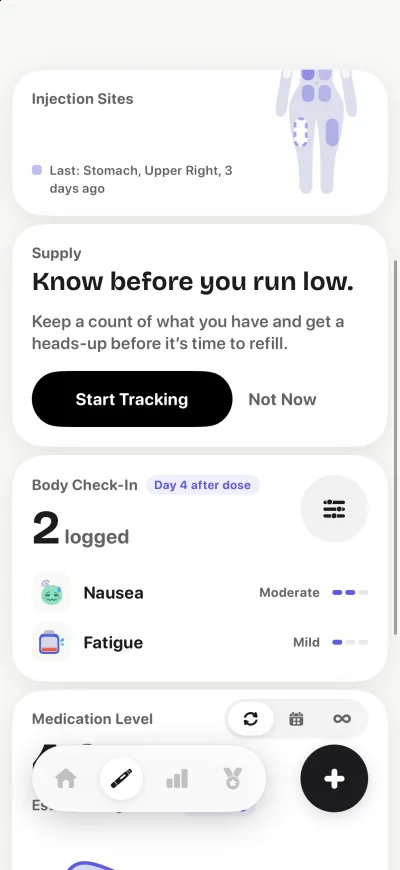
- Doses as your label reads: log the medication, amount, time and injection site, in mg, mcg or units, the way your label reads. PenPal never converts units or calculates a dose.
- Dose reminders: a heads-up at dose time, one to four hours before, or the evening before.
- Body Check-In: tap a symptom such as nausea, fatigue or reflux, pick mild, moderate or severe, and PenPal notes which day after your dose it is.
- Dose steps in your report: the PDF progress report lists each dose step with its first and last dose date and how many doses you logged at it, and shows your steps under the weight chart.
Pick the dates since your last appointment, and PenPal builds a PDF progress report with your doses, side effects, weight, nutrition, water and activity. You decide whether to share it, and with whom.
Sources
- MedlinePlus: Semaglutide injection
- MedlinePlus: Tirzepatide injection
- FDA: Wegovy (semaglutide) injection and tablets prescribing information
- MedlinePlus: Talking with your doctor
This guide is educational and doesn’t replace individual medical advice. Follow your prescription and talk to your clinician about your treatment.