 PenPal Editorial Team
Short answer: A GLP-1 pill log is one short line per daily dose: the product name, the dose as your label reads, the date and time you took it, a note on anything unusual about the day, and any side effects. It skips the injection site. How and when to take the pill comes from your label and pharmacist, not the log.
Which GLP-1 medicines come as a pill?
In the US, FDA labels list semaglutide tablets, taken by mouth, under the brand names Rybelsus®, Wegovy® tablets and Ozempic® tablets. All three are made by Novo Nordisk and come with their own prescribing information and Medication Guide.
MedlinePlus describes semaglutide tablets as a medicine taken by mouth once a day. The FDA label for Wegovy now covers both the weekly injection and the tablets, and DailyMed lists Rybelsus and Ozempic tablets on a shared label, each with its own tablet strengths. That’s a lot of similar names for one ingredient, which is exactly why a pill log should start with the brand.
This guide is about writing things down. It doesn’t say which pill is right for you, how much to take or how to take it. Those questions belong to your prescriber and pharmacist. For a wider view of what any GLP-1 record can hold, see our GLP-1 medication tracker guide.
What should a pill log record?
Record five things: the product, the dose as the label reads, the date and time you took it, a note on the day, and any side effects. Write each entry after you’ve followed your instructions, so the log shows what really happened.
| Field | What to write | Why it helps |
|---|---|---|
| Product | The brand name exactly as it’s printed on the pharmacy label | Several semaglutide tablets have similar names |
| Dose | Copied from the label, in the label’s unit | Tablet strengths differ between products; the label settles it |
| Date and time | When you actually took it | Daily routines blur by Thursday |
| Note on the day | Anything unusual: travel, illness, a new medicine, a busy morning | Gives your clinician context for a late or odd day |
| Side effects | What you felt, when, and how strong (mild, moderate, severe) | Turns “I felt off” into something you can describe |
Never use a log to work out a dose. If the label and your memory disagree, the label wins.
What does a week of entries look like?
A week is seven short lines, most of them boring, and that’s the point. The example below is made up and shows the format only. The dose column says “as on label” on purpose: copy your own label exactly.
| Day and time | Product and dose | Note on the day | Side effects |
|---|---|---|---|
| Mon, 6:40 AM | Rybelsus, as on label | Normal morning | None |
| Tue, 6:45 AM | Rybelsus, as on label | Normal morning | Mild nausea after lunch |
| Wed, 8:15 AM | Rybelsus, as on label | Overslept | None |
| Thu, 6:40 AM | Rybelsus, as on label | Started a new allergy medicine, told pharmacist | None |
| Fri, 6:50 AM | Rybelsus, as on label | Early flight | Mild fatigue |
| Sat | Not logged | Travel day, unsure. Question for pharmacist. | None |
| Sun, 7:00 AM | Rybelsus, as on label | Home again | None |
Notice Saturday. The log doesn’t pretend, and it doesn’t try to fix the gap. It writes down the uncertainty and the question, so the answer comes from someone who knows your product. Prefer paper? Our printable GLP-1 log has free PDF sheets you can adapt by leaving the site column empty.
What counts as a note on the day?
A note on the day is anything that made this day different from your usual routine. One line is plenty. You’re leaving a breadcrumb for future you, not writing a diary entry.
- Timing changes: you took it later than usual, or you’re not sure whether you took it.
- Other medicines: you started, stopped or changed another medicine or supplement. Mention it to your pharmacist too.
- Being unwell: a stomach bug, a fever or a rough night.
- Routine breaks: travel, a time zone change, a holiday.
- Supply: a refill picked up, a late refill, a bottle or label that looked wrong.
- Who you asked: what your pharmacist or prescriber told you, kept apart from your own guesses.
Keep facts and theories in separate places. “Mild nausea after lunch” is a fact. “The pill made me sick” is a guess that skips the facts your clinician needs. Our GLP-1 side effect diary guide shows a simple way to rate and review symptoms over a few weeks.
How is a pill log different from a shot log?
A pill log has no site column and usually one entry a day instead of one a week. Everything else is the same: product, dose as labeled, real time, notes and side effects.
The daily rhythm changes what’s useful. With a weekly shot, a single entry carries a lot of weight. With a daily pill, the pattern across many entries matters more: how often the time drifted, which days had notes, whether side effects clustered. Short, consistent lines make that pattern easy to read.
If your prescriber moves you between a pill and an injection, start a new line with the new product name, the date of the change and who made it. For weekly semaglutide pens, our Ozempic and Wegovy tracker guide covers the shot side, including injection sites.
Where do instructions for taking the pill come from?
From your prescription label, the Medication Guide and your pharmacist. Semaglutide tablets come with specific instructions about how to take them, and they differ by product, so this guide doesn’t repeat them.
MedlinePlus says to take semaglutide exactly as directed and to ask your doctor or pharmacist about anything you don’t understand. You get a Medication Guide when you start and with each refill. If you’re unsure about a missed, late or doubled dose, write down what happened and ask your pharmacist. Don’t let a log, an app or a guess decide.
How do you bring the log to an appointment?
Summarize the last four to eight weeks on a page: any product or dose changes on the label, days with notes, side effects and how often they showed up, and your open questions.
With daily entries, a summary beats a stack of pages. “Took it every day but two; mild nausea on five days, mostly in week one” is easier to discuss than 56 rows. Bring the detailed log too, in case your clinician wants a closer look. Our guide to a progress report for your doctor shows how to fit doses, weight and symptoms on one page.
How PenPal logs GLP-1 pills
PenPal has a Pill routine for daily GLP-1 pills, without injection details. You pick your tablet from the medication list, enter the dose the way your label reads, and log the date and time. There’s no site step. PenPal never converts units, calculates a dose or tells you how to take your pill.
- Products: Rybelsus, Wegovy tablets and Ozempic tablets are in the list, along with other GLP-1 medicines.
- Daily schedule: choose Every Day, or pick set days or a custom interval if your plan says so.
- Reminders: get a heads-up at dose time, one to four hours before, or the evening before.
- Late doses: change the date and time so the log shows when you really took it.
- Body Check-In: log nausea, fatigue and other symptoms as mild, moderate or severe, or add your own.
- Supply: keep a count of the tablets you have at home and see roughly when you’ll need a refill.
- Estimated level: an estimated medication level curve drawn from your logged doses and published values. It’s an estimate, not a lab result.
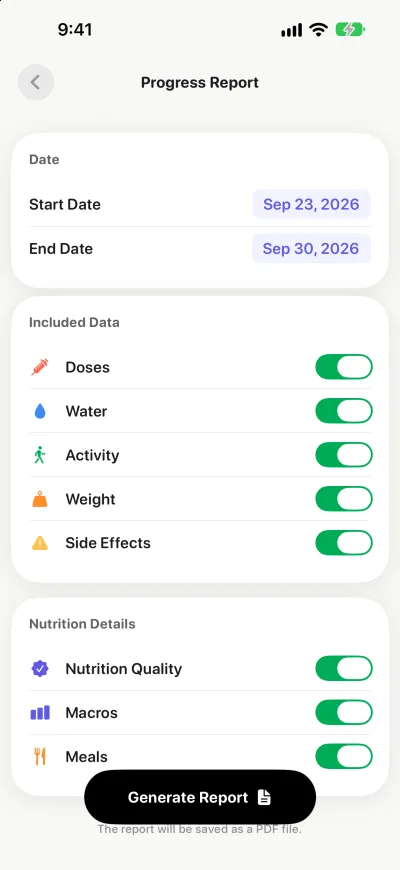
- Sharing: export a PDF progress report with your doses and side effects for the dates you choose.
If your prescriber switches you between a pill and a shot, you can change your routine type in Settings. See how PenPal tracks doses, pills included.
Sources
- MedlinePlus: Semaglutide (oral) (checked November 7, 2026)
- FDA: Wegovy (semaglutide) injection and tablets prescribing information (checked November 7, 2026)
- DailyMed: Rybelsus and Ozempic (semaglutide) tablets label (checked November 7, 2026)
This guide is educational and doesn’t replace individual medical advice. Follow your prescription and talk to your clinician about your treatment.