GLP-1 weekly check-in: a 10-minute routine to review your week
 PenPal Editorial Team
Short answer: A GLP-1 weekly check-in is a short review you do on the same day each week, often your dose day. In about 10 minutes, look back at your doses, side effects, meals, water, your weekly weight average, steps, sleep, mood and non-scale wins, and write down any questions for your next appointment. It describes your week; your clinician helps you decide what it means.
Why does a weekly check-in help on a GLP-1?
Daily logs are full of noise. One salty dinner moves the scale. One rough day after a dose feels like the whole week. A weekly check-in steps back far enough to see the pattern, but not so far that you forget what happened.
Keeping records is a well-studied habit. A systematic review of 22 weight-loss studies found a consistent link between self-monitoring (of diet, exercise or weight) and weight loss. The authors also called the evidence weak, mostly because of how the studies were designed. So a log is not magic. It is a clear record, and clear records make better conversations with your care team.
The NIDDK says tracking your progress helps you spot your strengths and find areas where you can improve. It also suggests writing down how you felt, not only what you did.
Whether you take Ozempic®, Wegovy®, Mounjaro®, Zepbound® or another GLP-1 medication, the routine is the same. Many people call it a GLP-1 journal or an Ozempic journal. Here is how to fit it into 10 minutes:
- Pick one day. Dose day works well for weekly shots, because it is already on your calendar. If you take a daily pill, any fixed day is fine.
- Open your logs. Your app, a notebook or a printable log.
- Fill in the template below. One short line per row. Blank rows are allowed.
- Answer three or four questions. Pick from the list further down.
- Add any questions for your clinician. Then close the notebook. You’re done.
What should a GLP-1 weekly check-in cover?
Ten rows cover most weeks. You don’t need numbers for all of them. A word like “good,” “okay” or “low” is often enough. Here is a template with a made-up example week. Copy the first two columns and fill in your own.
| Area | What to note | Example week (made-up) |
|---|---|---|
| Doses | Each dose as your label reads, with the date; anything late or missed, as it happened | Dose on Monday, as planned |
| Side effects | Which ones, how strong, and which days after the dose | Mild nausea on day 1 and day 2, gone by Thursday |
| Appetite and meals | How hungry you were; whether meals had protein and fiber | Small lunches early in the week; protein at most dinners |
| Water | A rough count, and any low days | Lower on Tuesday, back to usual by Thursday |
| Weight | This week’s average, not a single morning | Average about the same as last week |
| Activity and steps | Your weekly step average or the walks you took | Three walks; steps a little higher than last week |
| Sleep and energy | One word per day, or one for the week | Two short nights; energy okay |
| Mood | How you felt overall; any stress | Calm, busy at work |
| Non-scale wins | One to three things that went better | Took the stairs at work without stopping |
| Questions | Anything for your next appointment | Is nausea on day 1 and 2 worth mentioning? |
A few notes on the rows that need more care:
- Weight: add up the week’s weigh-ins and divide by how many you have. Our guide to tracking weight on a GLP-1 without obsessing shows the math with an example.
- Meals: a rough estimate beats a blank. See how to track protein and fiber on a GLP-1.
- Water: note the pattern, especially on days with stomach symptoms. Our water intake guide covers what to watch for.
- Activity and sleep: the CDC publishes general guidelines for physical activity and sleep. They are general references, not personal targets. Your clinician can tell you what makes sense for you.
Which questions should you ask yourself each week?
Questions turn a list of numbers into a short story. You don’t need to answer all of them. Pick three or four, and keep the same ones for a while, so the weeks are easy to compare.
- Did I take each dose as planned? If not, what happened?
- Which side effects showed up, and on which days after my dose?
- Were they milder, stronger or about the same as last week?
- How was my appetite? Did most meals have a protein source?
- Were my lowest water days the same as my rough days?
- How does this week’s weight average compare with the last three or four weeks?
- How did my energy, sleep and mood hold up?
- What went better this week than a month ago?
- What made this week harder, like travel, illness or stress?
- Is there anything I want to ask at my next appointment?
If you want more ideas for the “what went better” question, our list of 30 non-scale victories to log has plenty.
How do you read trends across weeks without judging yourself?
One week is a snapshot. Four weeks start to show a direction. Read your check-ins side by side, and look for patterns rather than grades.
- Compare like with like. This week’s weight average with last week’s average. Not Monday with Monday.
- Look for timing. Do side effects or low-water days cluster on the same days after your dose?
- Expect flat weeks. A week where the weight average doesn’t move is still a useful entry.
- Read the whole row. A flat scale next to longer walks and better sleep tells a different story than the scale alone.
- Name the context. A holiday, a cold or a stressful week explains a lot. Write it down, then move on.
Most of all, keep the tone kind. The NIDDK reminds readers that a setback does not mean you have failed. A higher weight average or a week of side effects is information, not a verdict. Write it the same way you would write a good week: plainly, with the facts. What a trend means for your treatment is a question for your clinician.
When should you contact a clinician instead of waiting for your check-in?
A weekly check-in is for patterns. It is not a reason to sit on something that worries you. Some symptoms need attention right away, whatever day it is.
For semaglutide injection, MedlinePlus lists symptoms that mean you should call your doctor immediately or get emergency treatment. They include:
- Ongoing pain that starts in the upper left or middle of the stomach and may spread to the back, with or without vomiting
- Rash, itching, fainting or dizziness, swelling of the eyes, face, mouth, tongue or throat, or trouble breathing or swallowing
- Decreased urination, or swelling of the legs, ankles or feet
- Vision changes
- Pain in the upper stomach, yellowing of the skin or eyes, fever or clay-colored stools
- A rapid or pounding heartbeat
- Severe stomach or intestinal problems
Other GLP-1 medications have their own lists, so read the Medication Guide that came with yours. MedlinePlus also says to tell your doctor if you have recently had diarrhea, nausea or vomiting, or cannot drink liquids, because these can cause dehydration. If your mood feels very low, or anything feels severe, contact a healthcare professional. In an emergency, call local emergency services. Then add it to your log afterward, so the full picture is there at your next visit. Our side effect diary guide shows what to note.
How does a weekly check-in feed your appointment report?
Appointments are short, and memory is patchy. If you have a check-in for each week since your last visit, most of your report is already written.
MedlinePlus suggests bringing a list of the questions and concerns you want to talk about, and writing down your symptoms, including when they started and what makes them better or worse. Your weekly entries cover exactly that. Before the visit:
- Line up your check-ins since the last appointment.
- Note the weekly weight averages, from first to latest.
- Summarize side effects: which ones, how often, and whether they faded.
- Pick your top three non-scale wins.
- Collect the questions from each week into one list.
Our guide on making a GLP-1 progress report for your doctor shows how to fit all of this onto one page. After the visit, write the answers into your next check-in, in your clinician’s words.
Common weekly check-in mistakes
- Making it too long. If it takes an hour, you’ll stop. Ten rows, one line each.
- Judging the week by one morning. Use the weekly weight average, not your lowest or highest weigh-in.
- Only checking in on good weeks. Hard weeks are the ones your clinician most needs to hear about.
- Changing your questions every week. Keep the same few for a month so the weeks can be compared.
- Comparing with someone else. Forum timelines aren’t your plan. Compare this week with your own past weeks.
- Using the check-in to change your treatment. Your log describes what happened. Dose and timing decisions belong to your prescriber.
- Waiting a week to report something worrying. Contact a clinician right away, then log it.
How PenPal helps
PenPal collects most of your check-in as you go, so on check-in day you review instead of rebuilding. It records what you log; it doesn’t tell you what your numbers mean or suggest treatment changes. See the progress report.
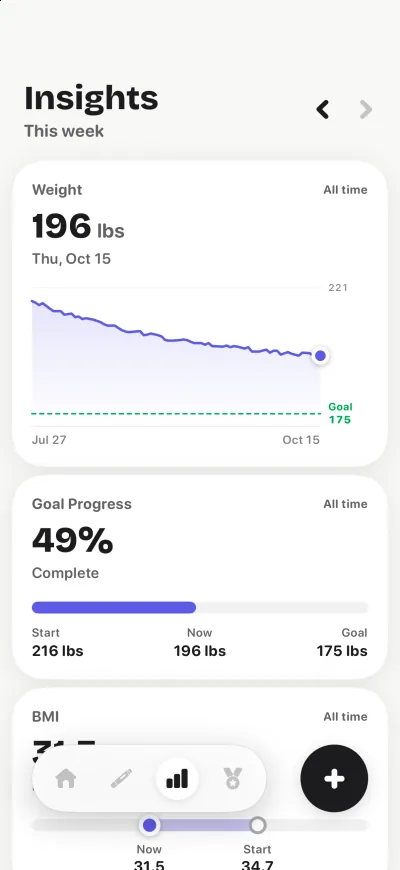
- Insights, week by week: see your weight line and goal progress, then weekly cards for protein, fiber and water day by day, active calories, and the days with side effects. Arrows switch to earlier weeks, so you can compare.
- Doses as your label reads: log each dose with its amount, time and injection site. PenPal never calculates or suggests a dose.
- Body Check-In: tap a symptom such as nausea or fatigue, pick mild, moderate or severe, and PenPal notes which day after your dose it is.
- Steps from Apple Health: if you turn it on, PenPal reads your steps and workouts from your iPhone or Apple Watch.
- A PDF report: pick the dates since your last visit, and PenPal builds a report with your doses, side effects, weight, nutrition, water and activity. You decide whether to share it.
PenPal doesn’t record mood, sleep notes or non-scale wins, so keep those rows in a note on your phone or in a notebook, and bring them along.
Sources
- Burke LE, Wang J, Sevick MA. Self-monitoring in weight loss: a systematic review of the literature. J Am Diet Assoc. 2011 (PubMed)
- NIDDK: Changing your habits for better health
- CDC: Adult activity, an overview
- CDC: About sleep
- MedlinePlus: Semaglutide injection
- MedlinePlus: Talking with your doctor
This guide is educational and doesn’t replace individual medical advice. Follow your prescription and talk to your clinician about your treatment.