 PenPal Editorial Team
Short answer: You don’t need a food scale for a useful meal log. A photo, a quick comparison with your hand or a household item, the label when there is one, and saved repeat meals get you close enough. For a personal log, steady rough estimates show your patterns better than perfect numbers you stop recording.
Do you need a food scale to keep a useful meal log?
No. A scale gives precise grams, but most people stop weighing within a few weeks. A log that’s roughly right every day tells you more than a precise one that stops in week two.
On a GLP-1, portions often get smaller, so what’s on the plate matters more. The questions a personal log answers are simple: did this meal have a clear protein source? Was there something with fiber? Which days were light, and which felt off? You can answer all of those without weighing anything.
If your clinician or dietitian has asked you to measure food precisely, follow their instructions. This guide is about keeping a personal record with less effort, not about how much to eat. For the bigger picture of what a log can include, see our GLP-1 medication tracker guide.
How do you estimate a portion from a photo?
Take the photo before the first bite, from above or at a slight angle, with the whole plate in the frame. The plate itself becomes the ruler: half a plate of rice and a quarter-plate of chicken is far easier to judge than a cropped close-up.
- Get the whole plate in. Include the rim, so the size of the plate is clear.
- Add something for scale. A fork or a glass nearby helps you, and an app, judge size.
- Use good light. Bright, even light beats the flash. Daylight is best.
- Note what the camera can’t see. Oil in the pan, butter on toast and dressing mixed into a salad don’t show up in a photo.
- Shoot seconds too. A second helping is a second photo, or a quick note.
Even if you log later, a photo taken in the moment makes the estimate much easier. Your camera roll becomes a backup food diary.
How do hand and household comparisons work?
Compare each food to something you always have with you, and use the same comparison every time. Your own hand works well because it never changes size. The aim is consistency, not an exact conversion to grams.
| Food | Compare it to | How you might log it |
|---|---|---|
| Chicken, fish, tofu, steak | Your palm (size and thickness) | “Palm-sized salmon fillet” |
| Rice, pasta, oats | Your fist, or a mug | “About a fist of rice” |
| Vegetables, salad | Two open hands, or part of the plate | “Half the plate of roasted vegetables” |
| Beans, lentils | A cupped hand, or a ladle | “One ladle of lentil soup” |
| Cheese, nut butter, oil | Your thumb, or a spoon | “Thumb of cheese, a spoon of olive oil” |
| Yogurt, cottage cheese | The container, or a cereal bowl | “Half a tub of Greek yogurt” |
Describe the food, not your judgment of it. “Palm-sized salmon, half a plate of vegetables” is useful. Words like good, bad or cheat aren’t, and they make logging feel like a test.
Measuring cups and spoons are a handy middle ground. Pour your usual bowl of cereal or yogurt into a measuring cup once, and you’ll know what “my usual bowl” means from then on.
How do food labels help when you don’t weigh food?
Labels do the math for packaged food, as long as you count servings rather than grams. Check the serving size, see how many servings the package holds, and log the fraction you ate.
The FDA notes that a label’s serving size reflects how much people typically eat. It isn’t a recommendation of how much you should eat. Every number on the label, including protein and dietary fiber in grams, is for one serving. If you eat two servings, double them.
NIDDK draws the same line: a serving is the amount on the label, while a portion is how much you actually choose to eat. They often differ, which is exactly what your log should capture. A few shortcuts:
- Single-serve packs are the easiest: one pack, one serving.
- Shared packages: log “half the bag” or “a quarter of the tub,” then work out servings from the label.
- Barcodes: many apps can scan a barcode and pull the label for you.
- Foods without a label: USDA’s FoodData Central lets you look up nutrient values for generic foods like apples or cooked lentils.
What about meals you eat again and again, or eat out?
Repeat meals are where you save the most time. Log your regular breakfast or go-to lunch carefully once, then reuse that entry. Most people eat a small rotation of meals, so a handful of saved entries covers much of a week.
- Name your regulars. “Usual yogurt bowl” or “Tuesday chicken wrap” is quicker to find than a list of ingredients.
- Note changes, not the whole meal. “Usual bowl, extra berries” is enough.
- Batch cooking: estimate the whole pot once, divide by the number of portions, and log one portion each time.
For restaurant meals, describe what arrived: “burrito bowl with chicken, rice, beans and salsa.” Many chain restaurants post nutrition information on their menus or websites. If you take half home, log the half you ate. NIDDK suggests sharing a dish or taking half home when restaurant portions run large.
How rough can your protein and fiber numbers be?
Rough enough to spot a pattern. For a personal log, it matters more that a meal had a clear protein source and something with fiber than whether the total was a few grams higher or lower.
A simple way to estimate without numbers is to ask two questions per meal:
- Protein: what was the main protein source, and roughly how big was it? Meat, fish, eggs, tofu, beans, Greek yogurt and cottage cheese all count.
- Fiber: was there a vegetable, fruit, whole grain, bean or lentil? One serving, two, or none?
Then look at the week, not the meal. Seven days of rough estimates show which meals tend to be light on protein, or which days had little fiber. Your targets, if you want them, should come from your clinician or dietitian. Our guide on how to track protein and fiber on a GLP-1 covers a simple routine for that.
Precision matters more in a few cases: if your care team asked for exact numbers, if you’re preparing for a specific appointment, or if a rough log keeps raising questions you can’t answer. Then a few weeks of careful logging can be worth it.
What are the most common meal-logging slips?
Most gaps come from things that are easy to forget, not from bad estimates. These are the usual ones:
- Cooking fats: oil, butter and ghee used in the pan.
- Sauces and dressings: a spoon of mayo or a drizzle of dressing adds up.
- Drinks: juice, smoothies, milky coffee and alcohol.
- Bites and tastes: a few fries from someone else’s plate, or tasting while cooking.
- Logging days later: details fade fast. Log the same day, even roughly.
Missed a meal in the log? Add your best guess and move on. A rough entry is more useful than a gap, and nobody is grading it.
How does PenPal estimate meals from a photo or description?
PenPal is built for this kind of logging. Snap a photo of your plate, describe it in a few words, or scan a barcode, and its AI estimates calories, protein, fiber and macros. Estimates can be off, so every number is editable.
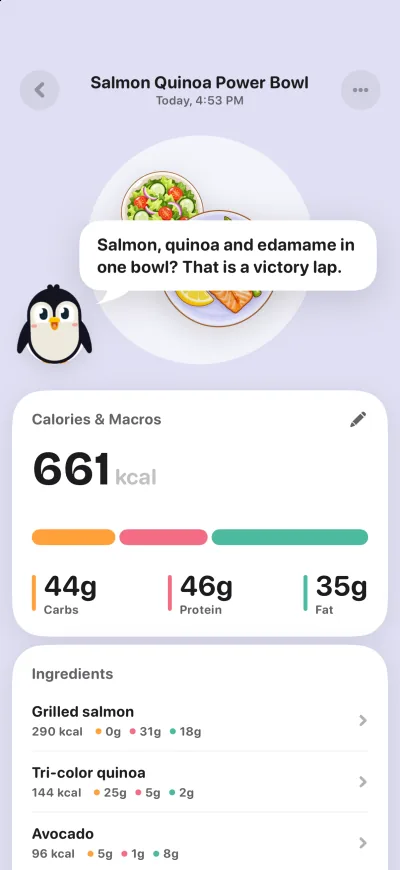
- Photo tips built in: the camera suggests getting the whole plate in, shooting from above with a fork or glass for scale, and taking the photo before the first bite.
- Fix it on review: add any oil or butter the camera missed and adjust portions before you save.
- Describe it: type “two eggs, toast and an apple” when a photo isn’t handy.
- Recent meals: pick something you’ve logged before instead of starting from scratch.
- Protein and fiber first: see how each meal and your day add up.
PenPal doesn’t set a diet or tell you how much to eat. See how the protein and fiber tracker works.
Sources
- FDA: How to Understand and Use the Nutrition Facts Label (checked November 7, 2026)
- NIDDK: Food Portions: Choosing Just Enough for You (checked November 7, 2026)
- USDA: FoodData Central (checked November 7, 2026)
This guide is about keeping a personal food log and doesn’t replace individual medical or nutrition advice. Talk to your clinician or a registered dietitian about your own needs.