How to keep an injection site rotation log
 PenPal Editorial Team
Short answer: Record the body area and side for every injection, along with the date and anything you noticed at the site. Then check the log before your next shot so you follow the rotation your medication’s instructions describe, instead of relying on memory.
Why rotation matters
GLP-1 injection instructions ask you to change sites from one shot to the next. With a weekly shot, last week’s site is easy to forget. A rotation log is a short written record of where each shot went, so you can follow your instructions without guessing.
The wording differs a little by medicine. MedlinePlus’ semaglutide information says to use a different site for each injection. Its tirzepatide information says to rotate injection sites with each dose. The Ozempic® prescribing information asks for a different site each week when you inject in the same body region. Your own product’s instructions are the ones to follow.
A log doesn’t replace those instructions. It just makes them easy to keep. For the full picture of what a GLP-1 log can hold, see our GLP-1 medication tracker guide.
What to record
For each shot, write the date, the body area, the side and anything you noticed at the site afterward. Add a question if you have one. That’s five short fields, and most entries take less than a minute to write.
- Date and time of the injection.
- Area: the area your instructions allow, such as the stomach, thigh or upper arm.
- Side: left or right, and upper or lower if you use more than one spot in an area.
- Site notes: redness, a bruise, tenderness or anything else you noticed afterward.
- Questions: anything to ask your pharmacist or clinician about your technique.
Which areas count depends on your product. For example, the Zepbound® prescribing information lists the abdomen and thigh, and the back of the upper arm when another person gives the shot. If someone helps you, add “given by” to your log too.
A sample rotation log
A rotation log can be one line per week. The example below covers eight weekly shots. The entries are made up and show the format only. The order of areas is just an example; use the areas and order your own instructions or clinician give you.
| Date | Area | Side | Site notes |
|---|---|---|---|
| Sep 7 | Stomach, upper | Left | None |
| Sep 14 | Stomach, upper | Right | None |
| Sep 21 | Stomach, lower | Left | Small bruise, gone in 2 days |
| Sep 28 | Stomach, lower | Right | None |
| Oct 5 | Thigh | Left | None |
| Oct 12 | Thigh | Right | Itchy for an evening |
| Oct 19 | Stomach, upper | Left | None. Ask pharmacist about the itch? |
| Oct 26 | Stomach, upper | Right | None |
Two things make this log useful. Each line names both the area and the side, so there’s no doubt later. And site reactions are written down the day they happen, which turns “I think my thigh was itchy once” into a clear note for your pharmacist.
A blank log to print
Prefer paper? Print this page or copy the blank table below into a notebook. It has room for eight weekly shots. Keep it next to your medicine, and fill in a line right after each injection, while the details are fresh.
| Date and time | Area | Side | Site notes and questions |
|---|---|---|---|
If you also log the medicine and dose, a full injection log works better. See how to keep a semaglutide injection log or a tirzepatide injection log; both include the site column.
Want a cleaner sheet? Download the printable GLP-1 shot and site log, a free PDF with a body diagram and 29 shot rows.
A simple way to follow your rotation
Pick the areas your instructions allow and go through them in the same order every time, writing each one down as you go. Before the next shot, look at the last few entries. A fixed order plus a written record means you never have to remember; you just read.
If your clinician or pharmacist gave you specific guidance on which areas to use, follow that over any general pattern.
A quick check before each shot:
- Read your last two or three entries.
- Find the next area and side in your usual order.
- Check your notes for a reaction you wanted to ask about.
- After the shot, write the new line straight away.
Common logging mistakes
Most rotation logs go wrong in small, fixable ways: the side is missing, the entry is written days later, or only the bad weeks get logged. Each mistake makes the log harder to trust when you actually need it.
- Area without a side. “Stomach” alone can’t tell you where you went last week. Always add left or right.
- Mixing up left and right. Use your own left and right, not the left side of a picture facing you. Pick one rule and stick to it.
- Writing it later. A line written a week later is a guess. Log right after the shot.
- Only logging problems. “None” is useful too. It shows that a site was fine, which helps when you compare weeks.
- Vague reaction notes. “Weird site” doesn’t help. “Pink patch, coin-sized, gone in two days” does.
Rotation log questions
People usually ask three things: paper or app, how long to keep the log, and whether it works for shots more often than weekly. The short answers: use whichever you’ll keep up, keep it for as long as you inject, and yes, the same fields work.
Paper or app? Paper is free and needs no setup. An app fills in the date for you, keeps the order and can’t get lost in a drawer. The best log is the one you’ll actually fill in every time.
How long should I keep it? For as long as you’re injecting. Older entries cost nothing, and they help if a reaction comes back months later. For a visit, the last four to eight weeks are usually enough to bring.
What about daily shots? Some GLP-1 medicines, such as liraglutide, are injected once a day rather than weekly. The fields stay the same; you just fill in more rows, and the time of day matters more. Follow the site instructions for your own product.
When to ask for help
Note any site reaction and mention it to your pharmacist or clinician, especially if it doesn’t fade, keeps coming back or worries you. Dispose of used needles the way your instructions and local rules say; the FDA explains how to use a sharps disposal container at home.
Bring your rotation log to appointments. A few weeks of dated site notes make it easier to describe a reaction than memory alone. Our guide to a progress report for your doctor shows how to put your notes on a page or two.
How PenPal remembers for you
When you log a shot in PenPal, you tap the site on a body map. PenPal remembers where each shot went and suggests where to go next, so rotating takes zero brainpower. Always follow the injection instructions that came with your medication. See the shot tracker.
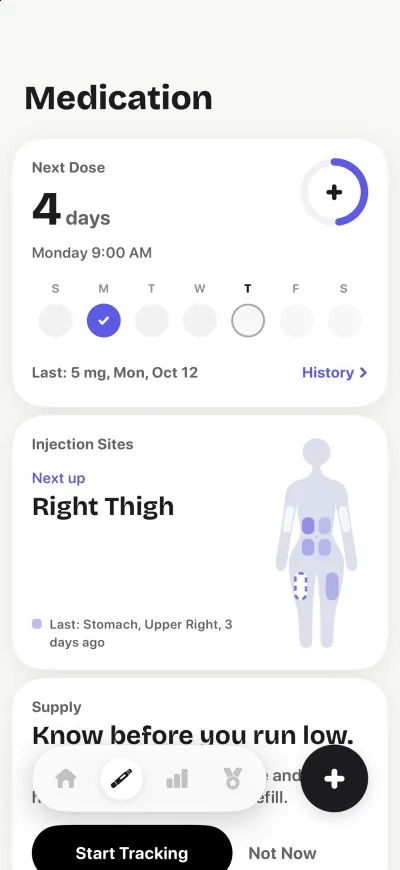
- Body map: ten zones, front and back: four on the stomach, plus left and right thigh, arm and buttock. Use only the areas your instructions list.
- Your own left and right: the map uses your left and right, so the record matches your body.
- Next in rotation: the zone you used longest ago, worked out from your own log.
- Recent sites: your last few sites, each with its date.
- Sharing: a PDF progress report lists each dose with its site.
The suggestion comes from your history, not from medical advice. If your clinician wants you to use certain areas only, simply tap those.
Sources
- MedlinePlus: Semaglutide injection
- MedlinePlus: Tirzepatide injection
- Ozempic (semaglutide) injection: Prescribing Information and Medication Guide
- Zepbound (tirzepatide): Prescribing Information and Medication Guide
- MedlinePlus: Liraglutide injection
- MedlinePlus: Subcutaneous (SQ) injections
- FDA: Best way to get rid of used needles and other sharps
Ozempic® is a registered trademark of Novo Nordisk A/S. Zepbound® is a registered trademark of Eli Lilly and Company. PenPal is not affiliated with either company. This guide is educational and doesn’t replace individual medical advice. Follow your prescription and talk to your clinician about your treatment.